Valve guide
Know your valve.
Four valve types cover most of what you'll find on site. Before you scan, a few quick checks tell you a lot: look at the handle (handwheel or lever?), watch the stem (does it rise when opened?), note the body shape, and read any markings cast or stamped into the metal — DN size, PN pressure rating and material codes such as GG25 or CF8M.
Gate valve
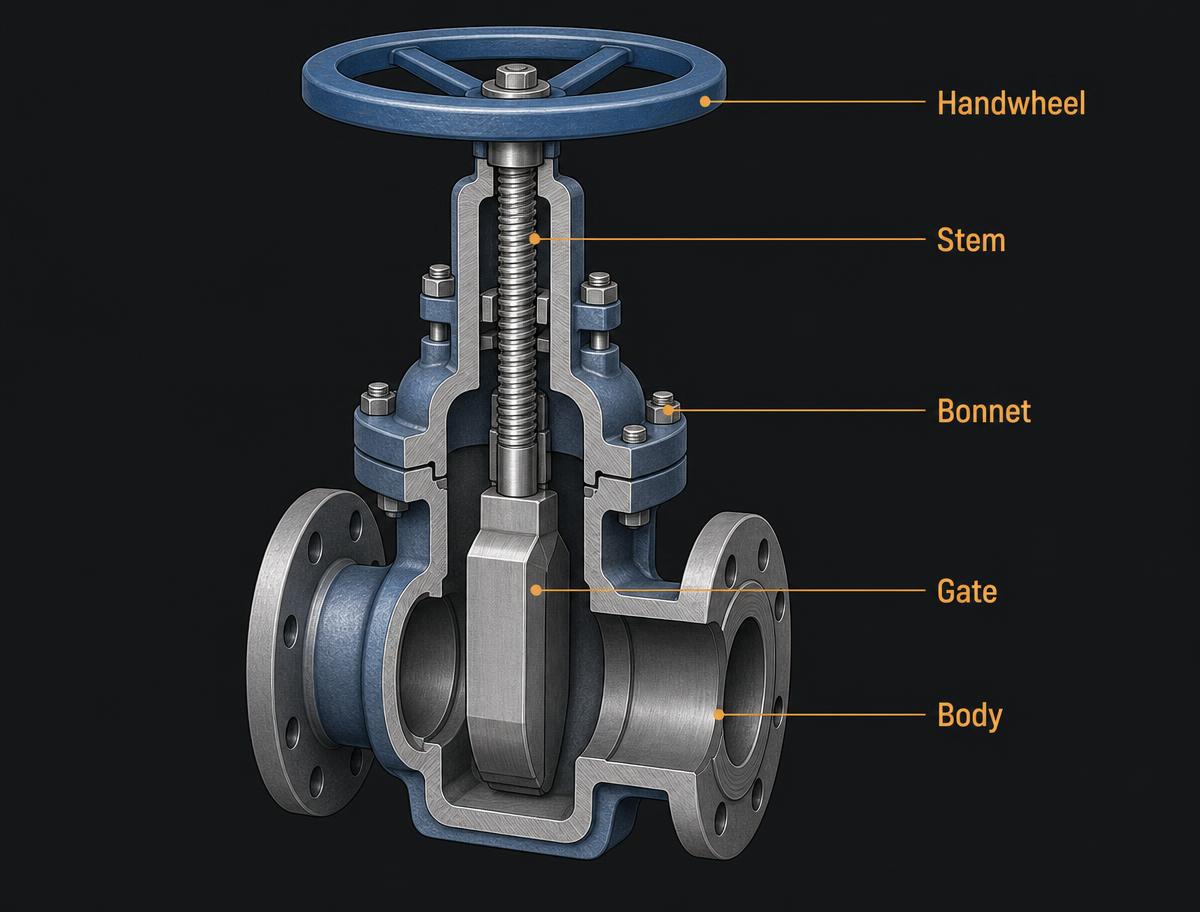
A gate valve opens and closes by raising or lowering a flat gate (a wedge or slab) across the flow. It is fully open or fully closed — never used to regulate flow part-way.
How to spot it
- A round handwheel on top — you turn it many times to open or close.
- A rising stem: on many gate valves the threaded stem visibly rises out of the bonnet as you open it.
- A tall, bulky bonnet (the housing above the body) because the gate needs somewhere to go when open.
- Flanged or threaded ends in line with the pipe — flow goes straight through.
Typical uses
Isolation duty on water, steam, oil and gas lines — sluice/gate valves on mains, ship systems and plant pipework where the valve stays open or shut for long periods.
Ball valve
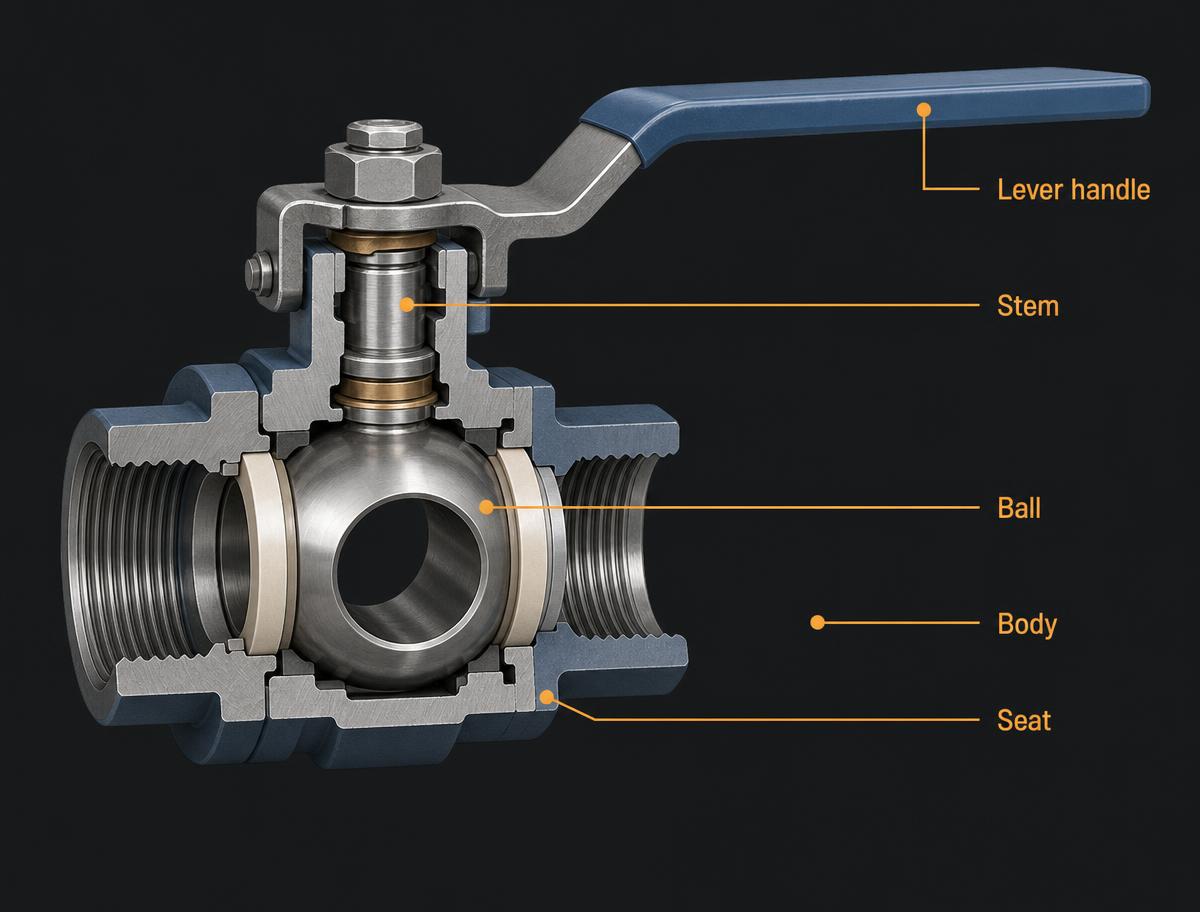
A ball valve uses a drilled ball that rotates a quarter turn. When the hole lines up with the pipe the valve is open; a 90° turn of the handle closes it completely.
How to spot it
- A lever handle, not a handwheel — a single quarter turn is enough.
- Handle direction shows the state: in line with the pipe = open, across the pipe = closed.
- A compact, chunky body — often much shorter than a gate valve of the same size.
- Common in small sizes with threaded or compression ends; larger ones are flanged.
Typical uses
Fast shut-off on fuel, air, water and chemical lines — anywhere quick, tight isolation matters. Very common in marine and process plant in sizes up to about DN100.
Globe valve
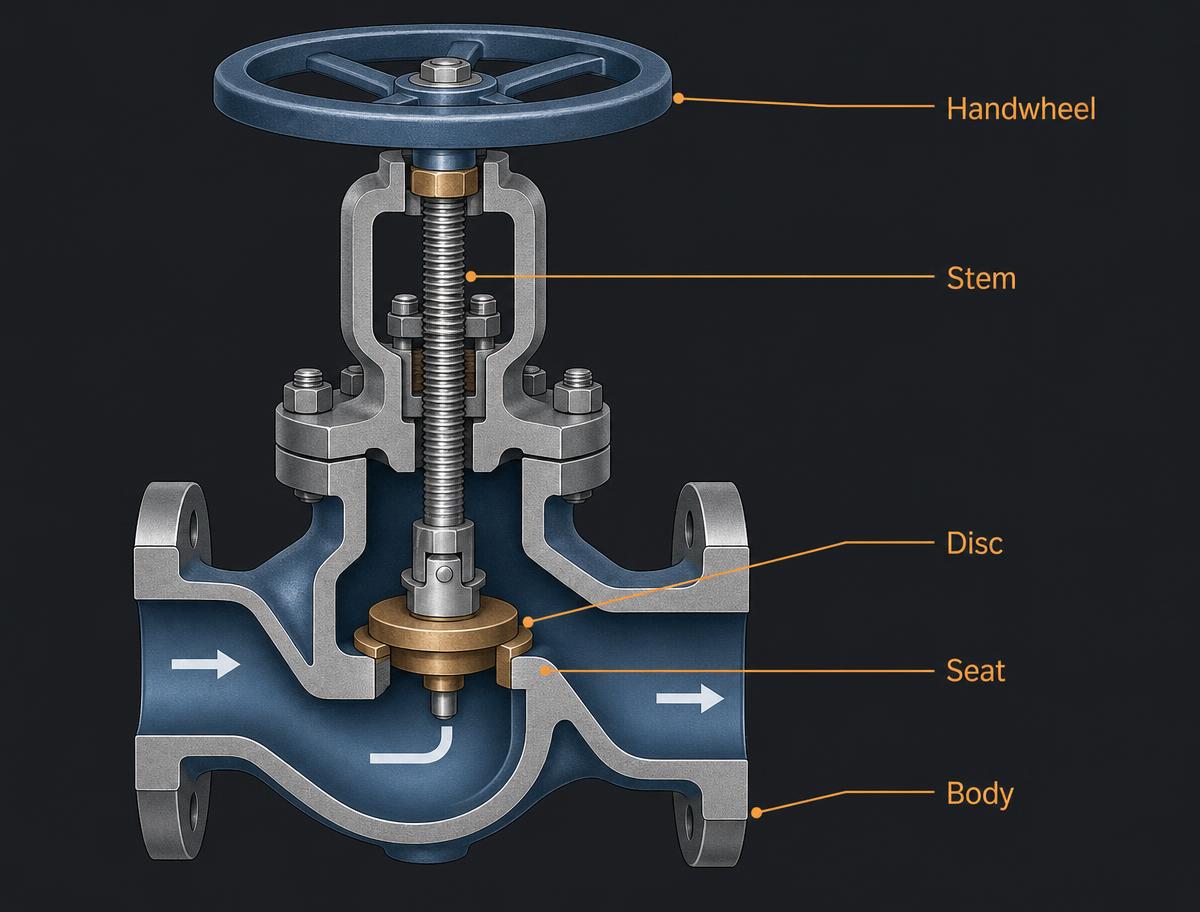
A globe valve moves a disc down onto a seat, and the flow inside takes a Z-shaped (S-shaped) path up and over the seat. That makes it ideal for throttling — controlling how much flows, not just on/off.
How to spot it
- A rounded, globe-shaped body with a clear bulge in the middle.
- A handwheel that screws the disc down onto a horizontal seat — several turns to open or close.
- The stem usually does not rise; the wheel stays at the same height.
- Often an arrow cast into the body showing the required flow direction.
Typical uses
Flow control and throttling on steam, cooling water and process lines — bypass lines, gauge and vent connections, and any duty where the valve is adjusted regularly.
Butterfly valve
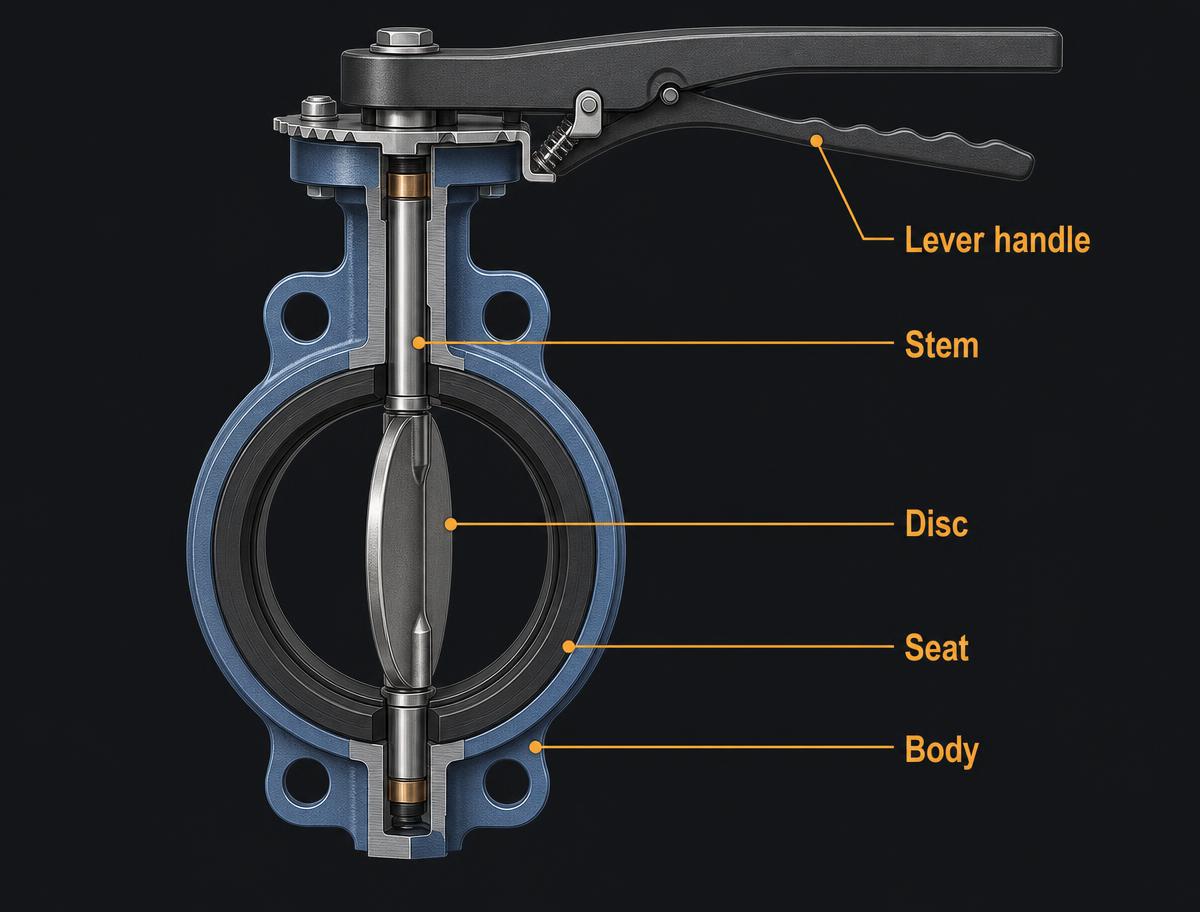
A butterfly valve rotates a thin disc inside the bore. A quarter turn takes it from fully open (disc edge-on to flow) to fully closed (disc across the bore).
How to spot it
- A very slim body — a flat ring sandwiched between pipe flanges, much thinner than any other valve type.
- A lever handle or a small gearbox with a handwheel on larger sizes — always a quarter turn.
- The disc is visible edge-on down the bore when open, like a butterfly wing — hence the name.
- Lugs or bolt holes around the rim instead of full flanges.
Typical uses
Large-diameter isolation and control on seawater, cooling water, HVAC and ballast systems — anywhere space and weight matter. Standard on ships from DN50 upwards.
Quick comparison
| Type | Handle | Stem | Body | Main job |
|---|---|---|---|---|
| Gate | Handwheel, many turns | Rises as it opens | Tall bonnet, in-line | Open / shut isolation |
| Ball | Lever, quarter turn | Short, no rise | Compact and chunky | Fast shut-off |
| Globe | Handwheel, many turns | Stays put | Round bulged body | Throttling / control |
| Butterfly | Lever or gearbox, quarter turn | Short, no rise | Slim ring between flanges | Large-bore isolation |
Not sure? Photograph it.
Take a few photos or a short clip and our identifier will tell you the valve type, how confident we are, and which products in our range match.
Identify a valve